A Knight in Shining Armour — Knight’s Heavy Towing
Rear Vision
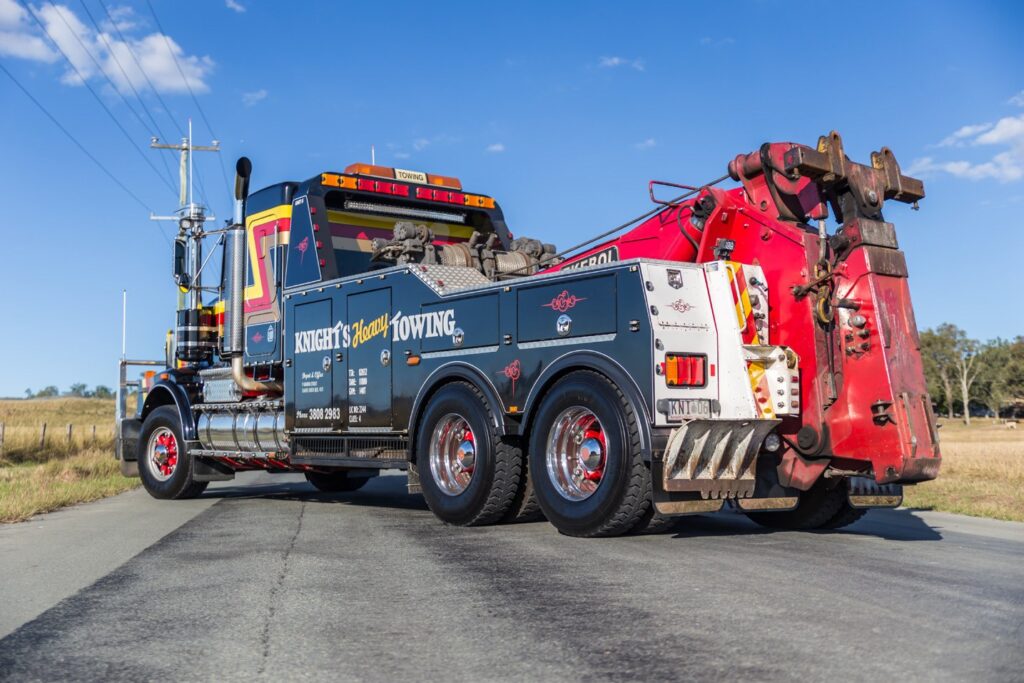
Rod Hill talks trucks, heavy recovery and the work behind Knight’s Heavy Towing.
Words by Chris Smith. Photography by Jack Duff.
Hands on is how you’d describe Rod Hill, the owner of Knight’s Heavy Towing.
Rod works in every part of his business and the phone doesn’t stop. Today is a rare treat, in this case a medium rare treat at one of his local haunts, The American Bourbon Bar & Grill at the Hotel Gloria in Springwood, Queensland.
We’re out of the Slacks Creek office so we can spend a bit of time discussing everything trucking and how Rod has built a reputable business with a stunning fleet …all while the phone is off, and no-one is asking for somthing.
Rodney is a bigger than life character in the heavy recovery industry in Queensland and has been for over 40 years.
He started his working life as a panel beater and this is when he got introduced to the towing industry.
The towing side of the business originally worked in with the panel beating.
He went into partnership with the panel shop owner and they built a tow truck together to bring work to the shop. A typical truckie, 43 years ago he even brought his daughter home from the hospital in the tow truck. Back then it was all light vehicles that he towed but after several years Rod moved into the bigger gear, only occasionally venturing back hauling the light vehicles.
The reason for the move was beause Rod believes there are too many little tow trucks and that part of the industry is simply too greedy and too hungry.
However, he also carved a niche in a market with very little competition at that time.
He tells me a few of the anecdotes about some of the places he has towed from, and what was involved, it was hard work, but the rewards looked after the family well.
Needless to say the choice in heavy apposed to light towing shaped the last four decades for Rod.
“I don’t believe in sitting on the side of a corner waiting for an accident,” he asserts.
“The heavy towing industry is definitely different, there are professional people in heavy towing, well we think we want to be professional, that’s why I changed from light to heavy towing.”
Rod maintains a passion for the industry and still gets a thrill going out to do a job.
The worst-case scenarios in this line of business can be traumatic and Rod puts his hand up to do this work. He says most of the time it is just the truck that needs to be towed and his drivers are not exposed to traumatic scenes.
He has the philosophy that he doesn’t expect anyone to do something he wouldn’t do and even further, he wouldn’t put his workers in a confronting situation.
He does his job exceptionally well and that has seen the business grow over the last 40 years.
Rod says that each individual job has its unique challenges and every day is different, even more so than a regular truckie’s day. He offers up some interesting examples of the variance in what can happen in a day in the life of a heavy tow truck recovery operator.
“You don’t know what you get from that phone call from the customer. You don’t know where you are going to go and what you are going to be doing,” he explains.
“You can have a rollover, a truck has been run off the road or bogged, it could be a call to transport equipment, boats, sumps, excavators, bobcats, tractors, you never know. A tree lopper could call you, “I need a hand to pull a tree down” because they want it dropped in a certain spot in between a couple of houses,” he explains.
“One of the interesting jobs has been the decommissioned cranes down on the wharf. When they decommission something down at the wharf they move them to a certain area, so the steel demolishing company can get a hold of it to recover the steel.
“Because the height of the cranes it was a difficult scenario to get people up on ladders to perform what they needed to do, it was easier to pull them to the ground, so we did.
“We got up there with a cherry picker, hooked the chains on, worked out the calculations of the height and how far we had to be back, and rolled them over.
“Then all they needed to do was bring in the excavator and chomp, chomp, the job was done!”
Rod doesn’t get too attached to a job, his philosophy is “you get paid then move on to the next one.”
This keeps everything moving nicely and how the business has grown from one truck to a fleet of eight.
The family business has grown organically with his wife Julie by his side from day one.
“What can I say, we’ve been married for 44 years, can’t say anything more than that. I wouldn’t be where I am without her backing,” he says fondly of Julie.
Their children are also involved with the business. Daughter Angela,43, works in the office alongside her mother while son Graham, 40, works as a driver.
Rod explains the organic growth is partly due to the cost of equipment in this side of the industry.
“It’s only a family business and you’ve got to fund everything yourself,” he says.
“When you’re borrowing nearly half a million dollars, sometimes much more, you can’t go out and hope it works, you’ve got to have the work to back it up.”
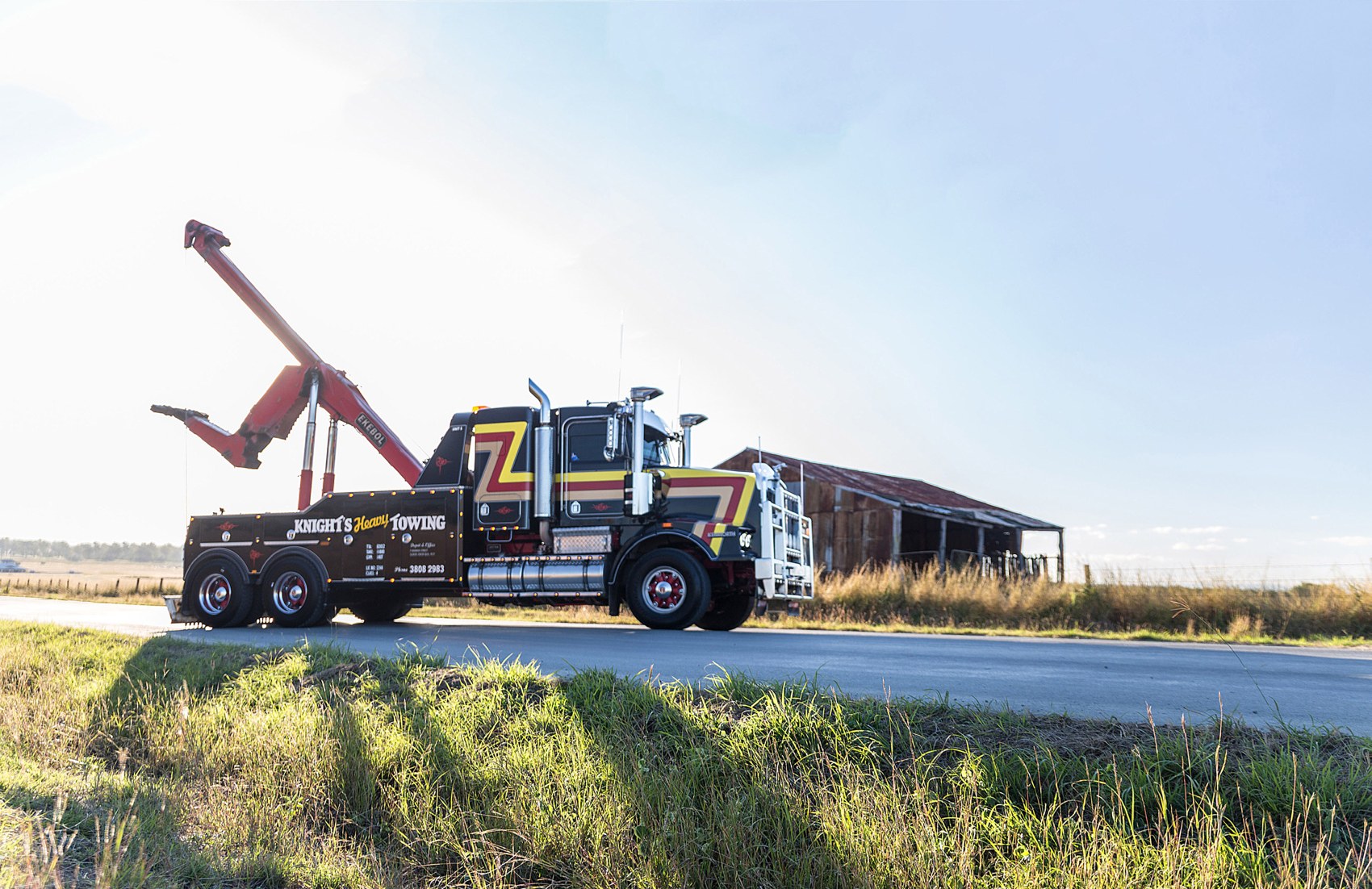
The cost is associated with the truck plus the heavy recovery under-lift units sitting on the rear of the recovery trucks.
Rod has found a proven formula in speccing his trucks, opting for refurbished second hand trucks with brand new heavy recovery under-lift units.
He tells ACT of his reasoning between choosing different heavy recovery under-lift units and different trucks in his fleet.
He explains the Ekebol unit fitted to three of his trucks, manufactured on Queensland’s Sunshine Coast, are a good unit, a bit heavier, more robust and has bigger winches than the American Century units he has for the rest of the fleet.
“The Ekebol is a very good unit but the cost of them in comparison to the Century unit I’m getting now from America is much more expensive,” he says.
“The trucks all have different capacities and different ratings. I’ve got three 140-tonne rated and four 90-tonne rated but then the backs are different on them, you get the TS22 back which is Ekebol, you get the Century 370 back, the whole thing you’ve got to think of your axle weight, towing capacity, horse power and then where you can and where you can’t get out of because I do a lot of work for Energex towing those generators around and you can’t have a 20 metre truck, you’ve got to have a realistic length truck to do what they want to do,” Rod explains.
“Some of these new estates now are that small you can’t even get around a roundabout so you’ve got to think about that too and the generators weigh 16-tonne so the truck has got to weigh more than 16-tonne because you can’t tow more than what you weigh.
“It’s a vicious little circle,” he admits.
As well as his knowledge in speccing trucks Rod has also been as strong supporter for industry associations and an advocate for change.
“I am a member of the National Road Transport Association (NatRoad), they are very good, they’ve got a big following within Australia through the trucking industry and offer a great format, they are excellent. The Queensland Trucking Association is also very good but restricted to Queensland as opposed to having a national presence,” he explains.
“I find the problem with the QTA is because there’s only a few heavy tow trucks in Queensland they don’t want to listen to our little bit and what we have got to say. They’re looking for the volume, well the towing industry hasn’t got volume, there’s probably six heavy tow truck firms in Queensland,” he tells ACT.
He says that being part of these organisations allows operators to have input into what’s happening throughout Australia, especially through NatRoad.
“What NatRoad is trying to do now is bring permits in line from state to state,” Rod says.
He says the irony of the current legislation allows for NSW tow truck operators to freely come over the border to Queensland and work however for Queensland operators they need to get a permit to work in NSW. The current scenario means QLD operators need to pay additional money for the permit and need to wait sometimes up to six or eight weeks for the permit to be approved.
If you are a QLD operator and get caught over the border, it’s a $10,000 fine!
He says there still isn’t a national tow truck certification or licence and NSW operators are required to pay more.
“In NSW you pay more for your smash book and your towing license than QLD. It doesn’t make sense and the variation between the NSW smash book and the QLD smash book is about $400.”
“When this change first happened, everybody complained because it infringed on of the right of free trade between states and they came back with, it’s our state, we make the rules, everyone comply otherwise don’t come in and that was their attitude,” he says.
Rod recognises tow truck operators are the minority in the industry but points to crucial laws in each state and territory facing the general transport industry being different, which is causing truck drivers and transport operators undue stress.
In the case of the towing industry he suggests the regulator needs to firstly segregate little tow trucks from heavy tow trucks and treat each as a separate vehicle class.
He believes the obstacle with this strategy is that firms that have both little and big tow trucks will resist this change even though the change would be highly productive for the heavy part of the industry.
“If the big tow trucks are all on the same playing field throughout Australia it would make things so much easier,” Rod states.
“If we had a standard specification, this is the weight needed on the steer, this is the weight needed on the drive and this is what you can tow. We could have one spec Australia wide with no bullshit.”
He adds that complicating the matter further Roads & Maritime Service (RMS) hasn’t even looked after tow truck licencing in NSW since 2017…the task is under another authority, it has gone to NSW Fair Trading, just to confuse the issue further.
“They’ve moved from one regulator to another regulator, now Fair Trading is involved, you don’t know who you’re talking to and they don’t seem to know our industry,” he says.
I am not sure if the irony is lost on the NSW bureaucracy having a system controlled by Fair Trading delivering a system that may be anything but fair trade.With a strong snapshot of what’s happening in the industry Rod switches to talking about the trucks in the fleet.
The one featured is a Kenworth T650 driven by his son Graham.
The fleet is made up of three Kenworth T650s, a Mack, a Kenworth T659, a T950, a T609 and a recently purchased K200. The K200 super tilt expands the operatiion by giving teh Company the flexibility to move up to 25t which could be excavators, bobcats, backhoes, site sheds, forklifts, damaged trucks, motor homes and much more.
The bulk of the fleet is Kenworth, but the Mack is there for a diplomatic reason.
“People don’t like seeing their truck being towed by a Kenworth if they’ve got a Mack,” he explains to ACT.
One of the most distinctive features of this fleet is the colour scheme, which Rod inherited from a SAR he bought when he was starting out.
“I bought an SAR out of Tasmania, well it was repossessed in Tasmania and made its way to Victoria, it was made by the fella that had built my 609 and was one of the original trucks in Tasmania made by American Truckworks in Adelaide,” he explains.
Rod saw an opportunity and made a bold move to get his second truck.
At that time Rod was one of the only two operators working in Queensland doing heavy towing.
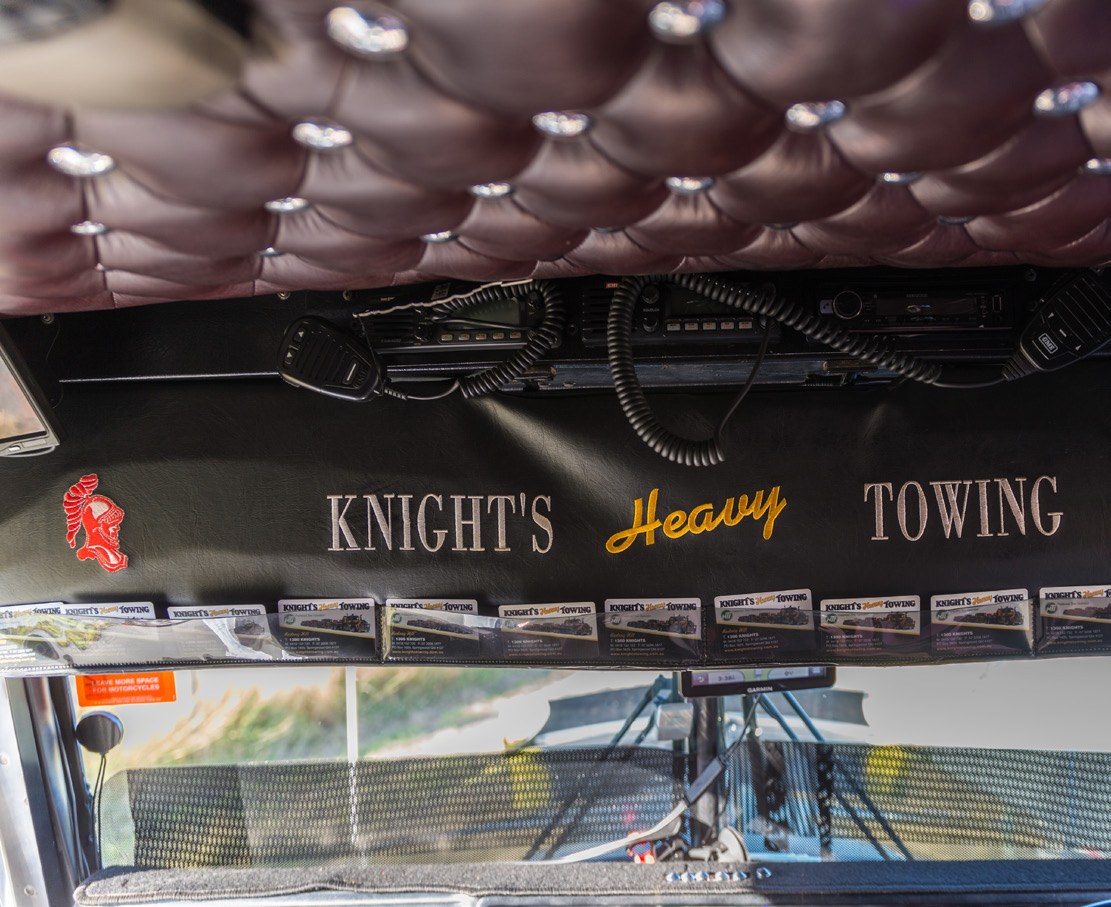
Today he has a one truck one driver policy and the drivers are the ones that shape the look and feel of the trucks.
“They take a personal interest in the truck, they look after it, they treat it as their own. The trucks don’t get swapped around from driver to driver, one driver has got the truck, he looks after it, he maintains it, he puts his own little stamp on it. Whatever they want,” Rod tells ACT.
“They’ll ask me for something and I’ll say, yeah, just go get it and I’ll pay for it. They’re taking pride in the truck, that’s what you’ve got to have. You’ve got to have somebody there to have pride in what they do.”
His son Graham is no exception to this rule and is the driver of KNI 06 featured in Australian Custom Trucks.
He says he and a good mate Mick Lake from Truck’in Stainless have added even further to the T650.
“Truck’in Stainless and I have done all the bling so far but I have put even more on since Jack Duff took the photos. We have added stainless front guards and I have changed my spiders to Alcoa rims on the front,” Graham tells ACT.
He has the same respect for the industry as his dad.
“I love my job, I like looking cool,” says Graham.
“Even if you are broken down on the side of the road. Even though it didn’t get you home it still looks cool when you are on the side of the road waiting for another tow truck to come and pick you up.
“If you have a nice looking truck and a nice looking tow truck turns up, you feel more comfortable knowing that the tow truck operator is going to look after your truck but if you have some busted up has been tow truck and it’s got junk and shit everywhere you are going to be really sceptical of the tow truck operator,” he says.
“It is just the rule of thumb.”
Graham is fanatical about the appearance of his truck and admits, “I have washed it six time in the last two weeks.”
“It’s not cool to be cheap but it’s not cheap to be cool,” he concludes.
Specifications
MAKE – KENWORTH
MODEL – T650
YEAR – 1998
RATED AT – 140T GCM
ENGINE – 525HP N14 CUMMINS
GEARBOX – 18 SPEED ROADRANGER EATON FULLER
DIFFERENTIALS – ROCKWELL
SUSPENSION – KENWORTH BIG 6 (HENDRICKSON 6 ROD?)
UNDERLIFT
RATED AT – 100T
1ST HYDRAULIC WINCH – 45,000LBS CABLE LENGTH – 85 METRES
2ND HYDRAULIC WINCH – 45,000LBS CABLE LENGTH – 85 METRES
ADDITIONAL EQUIPMENT -REAR STABILISER LEGS, MOBILE PHONE, UHF RADIO, CB RADIO, FIRE EXTINGUISHER, OXY CUTTING EQUIPMENT, SNATCH BLOCKS, RECOVERY CHAINS, FIRST AID KIT & ALL PERSONAL PROTECTIVE EQUIPMENT.
Rear Vision: where are they now?
Do you know where this truck is today, or have an update on its story? Tell ACT what happened next. We will verify current updates before adding them to the archive.