Perfection — Paul Cox’s 1979 Kenworth K100C Aerodyne
Rear Vision
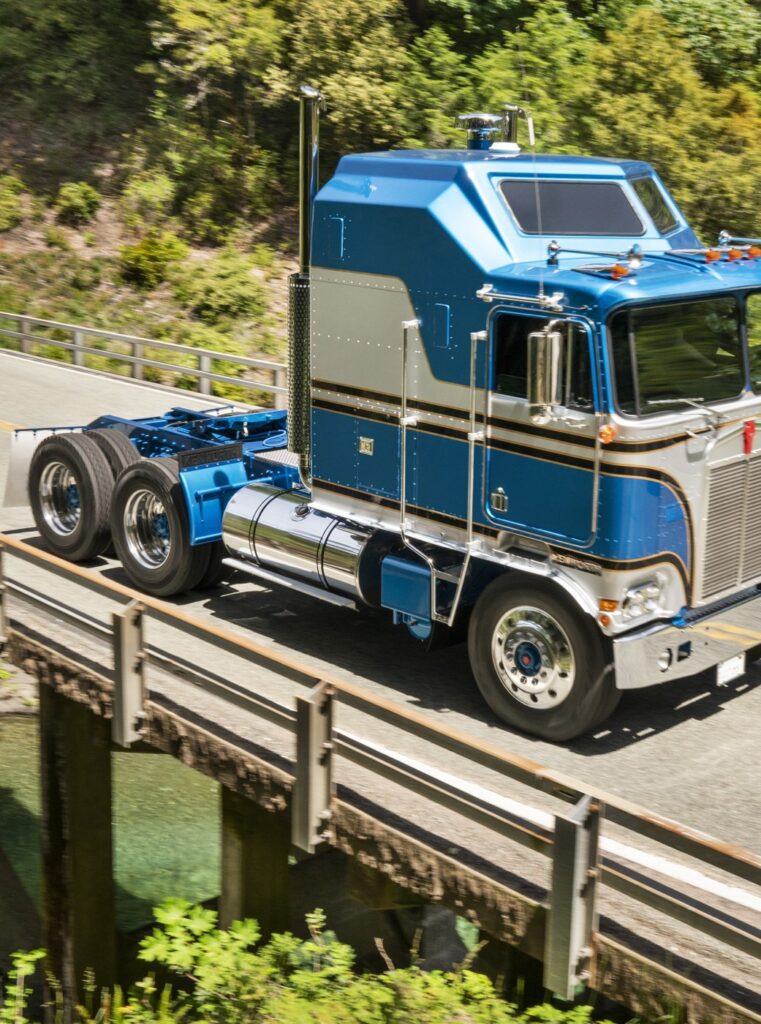
Paul Cox settles for nothing less than perfection when restoring a neglected Kenworth K100C Aerodyne.
Words by Steve Harvey. Photography by Roger Snider and Paul Cox.
I arrive at Paul Cox’s north Los Angeles workshop just as he’s finishing up another post-trip wash and polish.
With the California sun shimmering in the depth of the beautiful metallic blue and silver paintwork, Paul reveals more details, “I received a phone call from Detroit Diesel, their 80th Anniversary celebration was coming up and they invited five vehicles from across the USA to be displayed during the event at their manufacturing plant in Michigan.”
To be invited to attend a truck show based on engine type only is quite an unusual request, “Yes, it is, and I jumped at the opportunity. Everyone at Detroit Diesel was truly wonderful, so many people still work there from back in the day – second and third generations too, there’s a real sense of loyalty.”
Whilst the cab was tilted during the event one employee looked at the motor, got out a notebook, a pencil and scribbled down some information from the data plate.
He returned a short while later and said, “Hey, I dyno tested your engine right here in this very building – it’s been a long time since we’ve seen an 8V92 in here!”
Originally from England, Paul became interested in trucks as a child following a family vacation to Florida, where he saw his first U.S. truck stop. Seeing the 1978 film “Convoy” and the TV shows “B.J. and the Bear” and “Smokey and the Bandit” further stoked his interest.
“Seeing the Kenworth Aerodyne on ‘B.J. and the Bear’ when it aired in the U.K. had a huge impact. There was nothing like that in England. Owning one would be a dream come true, and thoroughly unreasonable, of course, which would only make it better,” says Paul, who had previously restored a 1956 Cadillac Coupe de Ville while living in London.
Years later, Paul relocated to California where he undertook another restoration, a 1956 Cadillac Eldorado Biarritz convertible that won numerous awards and was invited to appear at General Motors’ centenary show in Detroit in 2008. One day, while at a convenience store in Los Angeles, a classified ad in a local paper caught his eye: 1979 Kenworth K100C Aerodyne tractor, Detroit Diesel 8V92 motor, Fuller RTO 12515 trans, 4.11 rears, 108-inch cab with black VIT interior, 184-inch wheelbase, and aluminum frame. He went by the next day to take a look.
The truck looked reasonable from a distance, but it had many problem areas. The cab wouldn’t tilt, the rear cab panel had a huge crease in it, the floors had substantial cracks, and the fiberglass engine tunnel was in pieces.
It had rained the previous night and the interior and dash were soaked. “The driver’s side door wouldn’t open as the cab was so tweaked,” Paul also recalls.
The overall mechanical condition was no better; the truck was one step away from the wrecking yard. Indeed, that was nearly its ultimate destination.
“The seller told me that the ad was the last one he was going to run. No one had been interested, not even for parts.
I said, perfect, I’ll take it!” he laughs.
His initial intention for the truck was to retain its 2.2 million-mile patina and just take care of some basic mechanical work, safety items, and cab structure repairs for DOT approval. With a roadworthy vehicle, and having just passed his CDL, his childhood dream would be complete.
He moved the truck into storage and began acquiring tools and parts, befriending his local KW dealers and spending hours on eBay.
“That 2-stroke sound is a big part of what I wanted. Also, even though everything else was completely shot on the truck, I was impressed that the aluminum frame didn’t have a single non-factory hole drilled; it was completely untouched. So, the 8V92 was rebuilt, I found a good engine tunnel from a parts truck, and the plan was underway.”
But after some investigatory paint-stripping, Paul discovered that a section had three-quarters of an inch of body filler covering a huge crease and split. “Someone had actually glued rivet heads into the Bondo. That’s when I knew I wouldn’t be happy unless I took the thing down to the ground and started over.” Thus began an eight-year restoration project.
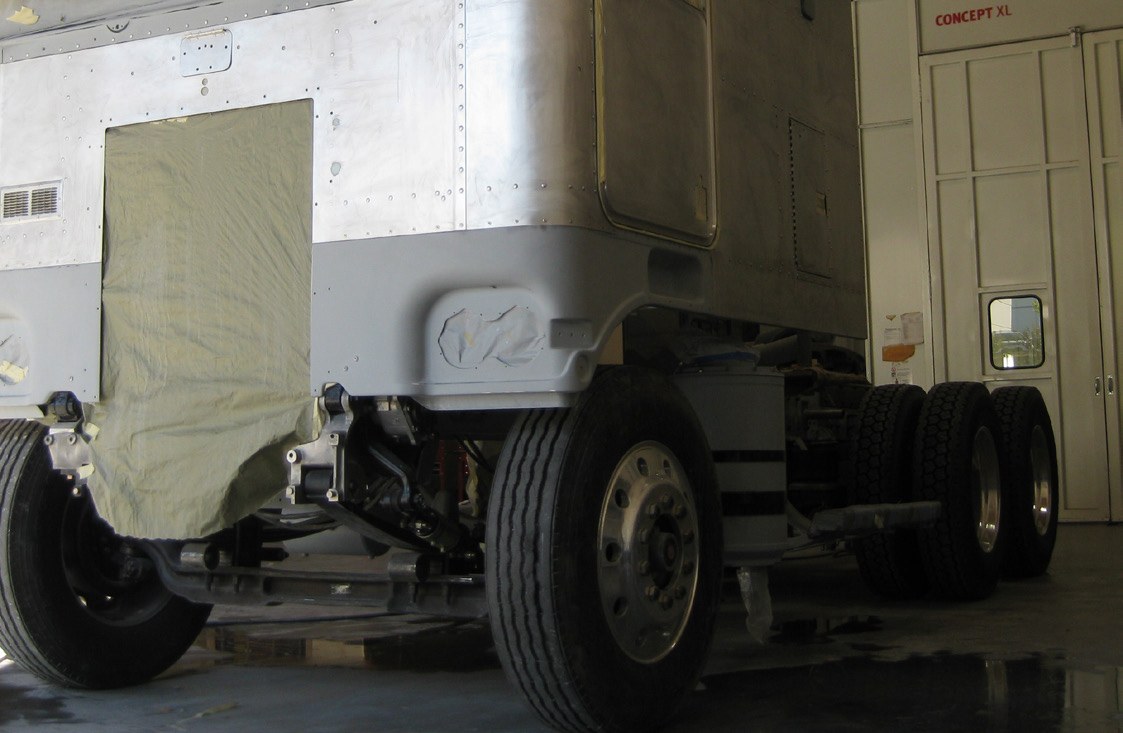
With the help of friend and automotive fabricator Sebastian Dominguez, Paul set about deconstructing the cab and creating new floor sections and rear panel, door, and side skins.
“I was lucky enough to find an NOS cab front panel, corner sections, door jambs, and frames. Apart from the fiberglass roof section everything else was fresh fabrication.”
For additional strength and longevity Paul used aluminum material one gauge thicker than the original.
He also re-engineered several structurally deficient areas of the cab. “The cabs kept getting longer from the factory and no additional reinforcement was engineered into the design,” he explains.
“KW did eventually offer a ‘severe duty kit’ after it was noted that the engine tunnels and floor sections could crack after a time, especially with the 108-inch bodies that were not fitted with cab air ride systems.”
But the factory reinforcement kit added only limited support.
“Now that my re-engineering improvements have been completed the fiberglass engine tunnel is purely a cover and no longer responsible for floor support structural integrity.”
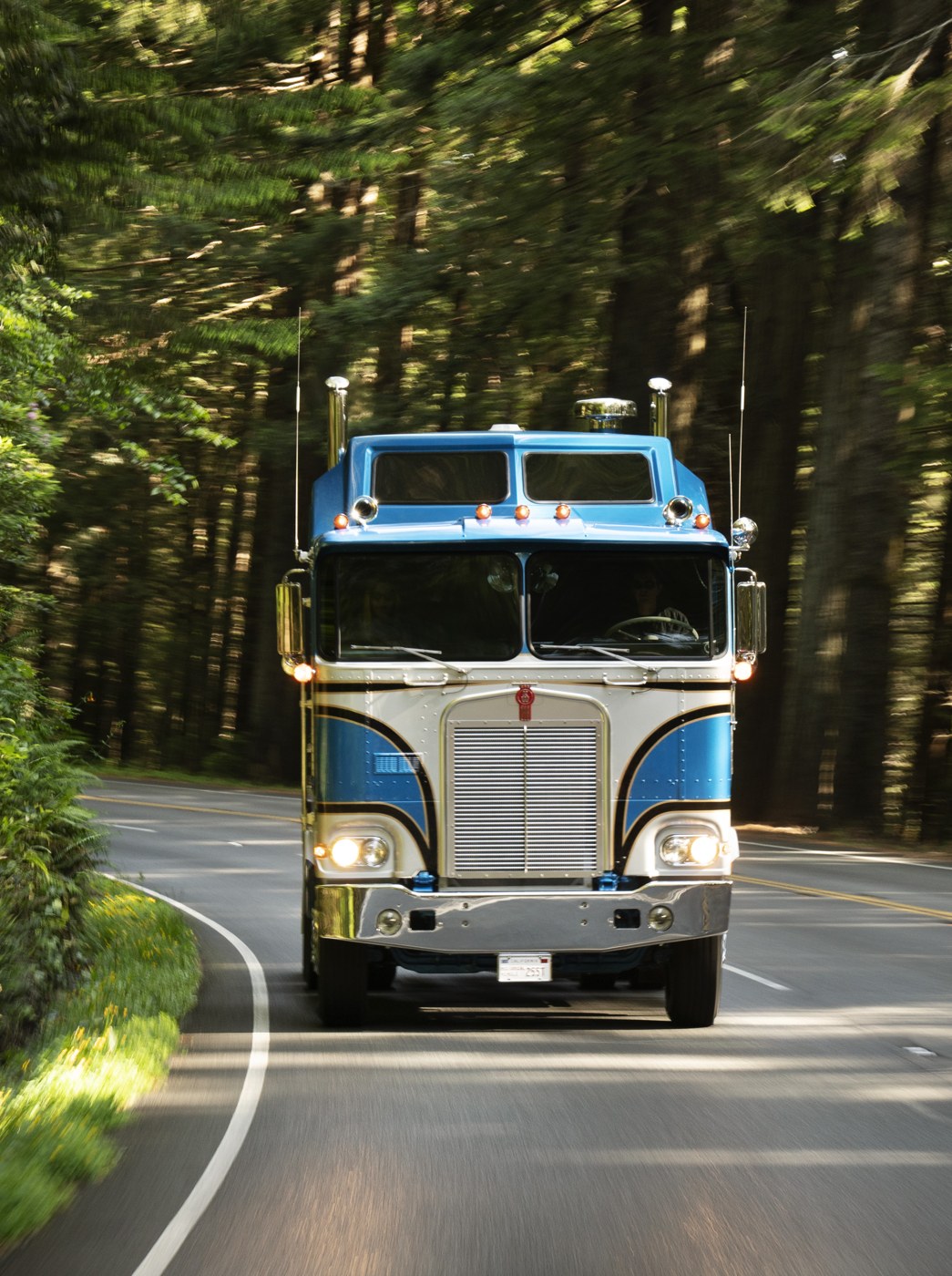
Paul chose one of the most popular factory designs, Salem, for the overall paint scheme.
“It’s such an iconic, classic KW look.
I’m a huge fan of metallic paints, the way they bring out the curves, especially the shape of the Aerodyne roof. I had the metallic blue and silver matched from a factory Kenworth Spectrum paint chip book that an ex-KW employee kindly gave me.”
There was still a lot of work to be done.
“After the paintwork is completed it’s easy to think you’re doing well, but that’s when the work really starts,” he says. First on the list was getting the interior upholstered panels underway.
“Even though this was a production built truck I wanted the interior to retain a factory correct appearance, but with everything fitting really nicely.”
He began by creating cardboard templates for every cab interior panel.
Plywood backing was cut to match the template and trial fitted. New black vinyl was diamond-stitched in preparation. “Each button was marked on the templates to ensure the retaining screws would be centered on the corresponding cab attachment points.”
The original Aerodyne interior roof panel with its cardboard form tends to sag over time. To eliminate this, Paul fabricated the backing out of aluminum, curved and shaped to fit like a glove.
Other interior details included having tooling made to emboss the KW logo on the door panels and upper seat sections. Additionally, every identification label, tag, and sticker was meticulously reproduced.
“The interior plastic trim restoration was a very time consuming project,” says Paul, with that “never again” look on his face. “The material itself gets brittle and cracks with age. Remember, these things were never meant to last 40 years.” With a combination of heat and wooden forms the original plastic pieces were persuaded into the required shapes.
The original upper vista window plastic section was all but gone. A donor section helped immensely. Paul explains, “Next to where I stored my truck at the start of the project there was a huge lot with every type of truck and associated trailers. I noticed a K100 Aerodyne parked there in a relatively poor state.”
Paul discovered the lot was owned by Hollywood stunt truck driver George Sack. “George and his son Errol are the masters of controlled jack-knifing.
George was also the stunt driver for ‘B.J. and the Bear,’ ‘The Terminator,’ and numerous other movies and commercials.”
George was able to provide the missing vista window plastic section.
As the factory fit wasn’t good enough, Paul cut it into eight pieces and temporarily fitted each piece to the desired location.
A moderate surface application of fiberglass matting and resin held the assembly together, enabling it to be removed as a single piece. Additional fiberglass work was done on the rear of all the items to fill in missing sections, fill cracks and holes, and to offer reinforcement to eliminate future problems. Finally, all edges and surfaces were sanded, sealed, and colored texturing was applied.
The interior insulation of the cab also underwent some upgrades. “Insulation has come a long way in 40 years,” says Paul.
“I installed three-quarter-inch residential Thermosheath in all the flat wall areas and multiple layers of double-sided foil jute on all curved areas.” Hushmat provided sound deadening on the inside of the doors and floor areas.
The truck’s electrical system was completely replaced. “I made molds of the original multipin connector blocks to retain the factory correct appearance,” he reports.
There were multiple electrical upgrades incorporated into the new wiring harness assemblies, including the addition of relays.
“These trucks were designed with only two relays in the system: clearance lights and horn. Everything else was wired directly through the dash switches. I guarantee every classic KW owner out there has dealt with burnt wiring on headlight and heater switch circuits.”
Paul reconfigured the original circuit breaker panel to add relays for every truck function.
“The modification only uses the original factory mounting holes on the panel — it’s all in the details!”
Every wire matches the original factory specification regarding gauge, color, stripe, and cable number.
“When I added a relay to a previously non-relayed circuit I would add the suffix ‘A’ to the new cable number handling the low current switch/relay activate line to retain consistency.”
Paul had accumulated as many NOS dash gauges as he could find. Several original gauges had to be reused, so they were taken apart and rebuilt.
“I reproduced the gauge inlays, such as the back-lit water temp gauge, with the correct material and had them silkscreened in three colors.”
There was an unexpected issue once all of the gauges were sitting on the bench ready to be installed into the newly fabricated aluminum and wood grained panels.
“The freshly rebuilt and silkscreened gauges made the NOS gauges look second rate,” he says. So the NOS gauges were similarly refurbished.
The audio systems of the truck were also upgraded.
“I never really liked the fact that KW didn’t give you a good place to put your CB radio,” says Paul.
He had invested so much time in the main fiberglass dash enclosure, he says, that he didn’t have the heart to hide a portion of it with a CB. But the original overhead radio location didn’t offer enough depth for a CB, so while he was working on the roof inner fiberglass areas and interior aluminum roof panel he strategically moved the overhead radio pod three-quarters of an inch to the right, enabling the radio to fit.
“I have a new ‘hidden’ radio which works via remote — the infrared sensor lens is part of the heater panel plastic overlay retainers — and I have Bluetooth, satellite radio, the full works.
You would never know by looking at it.”
Next, new braided air lines were fabricated and installed along with all new valves, fittings and relays.
The cab glass was replaced using the original pieces as patterns.
“I wanted to match the factory tints and to duplicate the upper vista window bronze tint took some doing,” he says.
“My glass guy took some time to locate a quantity of the correct film tint material and laminated the sections of glass accordingly.”
When Paul delivered his samples to the glass shop he encountered another coincidence.
“The guy looked at them, walked off to a dark dusty corner of his shop and returned with Masonite templates.
They had ‘NBC – BJ KW Aero’ written on them. This guy had made clear glass duplicates for the original show trucks. They replaced the factory-tinted glass with clear to allow more light for interior shots and better clarity when filming through the glass.”
To complete the glass reproduction the original manufacturer details and logo were duplicated and acid etched onto the new glass.
Many items were reproduced to satisfy Paul’s vision for the restoration. The exhaust heatshields were fabricated from scratch as nothing aftermarket or anything from the current KW parts line was close enough.
“I’m not happy with close enough,” he admits.
“There were many stainless-steel options, though nothing looks like chrome-plated steel. I also had to duplicate the rolled-over edges of the original heatshields — a small detail, but for me an iconic feature that I was not willing to compromise on.”
Paul also had to reproduce the factory gray cab skirt seals.
“The material didn’t resist UV rays; it would become brittle and crack.”
He had a small original sample piece that became the model for creating extrusion tooling. After being satisfied with the color match he chose a PVC material that is UV resistant and won’t crack.
One simple modification that has garnered much attention was Paul’s re-engineered door guide rod system.
“It’s simply the door opening travel stop,” he elaborates. “A steel rod travels through a hole in the door jamb and over time it grinds and wears a huge hole. Every classic KW owner will be familiar with the grinding sound and oval hole this makes.”
The improved assembly uses a stainless rod that glides smoothly and remains centered through a concealed custom machined block containing a stainless and Teflon-lined pivoting bearing.
“The simple things can make a world of difference. Ideally, for me, a restoration should be equal or better than factory standard,” he says.
In May of 2016 Paul finally had the truck back in one piece.
“I am very patient, though I have to say the moment I installed the drivetrain I was looking forward to turning the key and hearing that 8V92 come to life.”
The timing of the project completion was perfect for the American Truck Historical Society’s National Show in Oregon, a beautiful drive up the West Coast from Paul’s home in Southern California. Coincidentally, 2016 was the 40th anniversary of the Aerodyne.
“The ATHS shows are amazing, with a member base of over 22,000 each convention normally sees over 1,000 trucks, and you will always see something you have never seen before.”
Since completion, Paul has driven cross-country multiple times to appear at truck shows, “I restored this to drive it, it was never intended to be a trailer queen – I’ve just turned 12,000 miles of trouble-free total enjoyment.”
His bobtailing days are nearly over, as Paul explains, “A friend of mine recently saw an interesting trailer up in the San Francisco area – it’s a Great Dane 45’ exhibition and climate controlled electronics trailer.”
Two important details clinched the deal – it has early Neway air suspension and the ID plate confirms it was built in exactly the same month and year as the K100 tractor.
“For the trailer I’ll continue the Salem blue and silver paint scheme from the tractor down the trailer, looks as though I’ve got myself another project!”
Thanks to the Internet, there is now a substantial amount of information easily available for anyone conducting a restoration project.
“Whatever it is you are attempting to do or find, someone has already done it or has what you need,” says Paul.
Paul documented his Aerodyne’s entire restoration process online, which generated a great deal of interest over the years.
“This is the first restoration of a vehicle I have undertaken using the digital medium for documentation and reference purposes. Previously, I would dig through boxes of photographs looking for that one angle of something that I needed for reference. The joys of zooming in on an image and the ability to share the information easily is a huge advantage of digital images.”
Aside from his restoration interests, Paul’s main career in electronics is not truck-related at all. He is the first to admit he is just an avid enthusiast with a passion.
“I always wanted a brand-new Aerodyne, but 30 years had passed by, so I had to build one,” he laughs.
“This was my first semi-truck restoration. There certainly were plenty of sleepless nights, but overall I thoroughly enjoyed the process. It was worth the hard work for the reward of climbing into it, turning the key, and heading out on the highway.”
Rear Vision: where are they now?
Do you know where this truck is today, or have an update on its story? Tell ACT what happened next. We will verify current updates before adding them to the archive.