Check the pairing before choosing your truck’s mass-monitoring system
Story · October 15, 2026
By Chris Smith
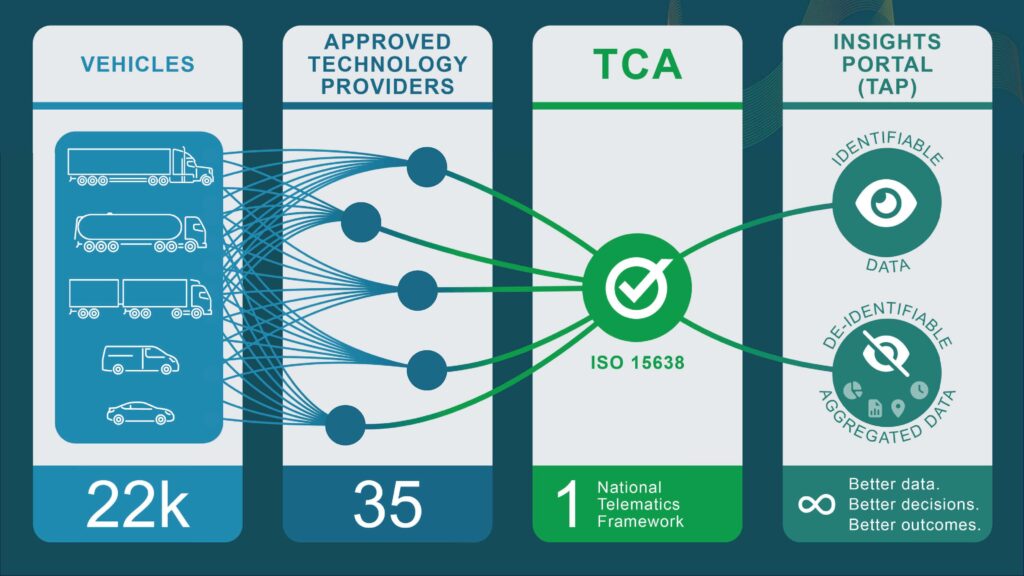
National Telematics Framework graphic: Austroads. Used with permission. Figures shown are those in the supplied graphic, not a current fleet count.
An operator shopping for a Smart On-Board Mass system can choose a product first, only to find that the existing TMA provider does not support it. The reverse can happen too: the monitoring contract is already in place, but the preferred weighing system is not one of its supported pairings.
Austroads general manager of strategic engagement and performance Gavin Hill described that purchasing problem in an interview with Which Way To Go. His advice was to understand the fleet’s starting position before committing to either part of the installation.
The Telematics Monitoring Application (TMA) uses an approved device and a certified provider to monitor vehicle use. Smart On-Board Mass (Smart OBM) supplies mass measurements where the scheme requires them. TCA’s current material says a Smart OBM system needs to be paired with a certified application service provider that supports it, and TCA publishes the current pairing table.
Existing fitment can shape the options
For a trailer already carrying onboard weighing equipment, the question is whether that exact system is type-approved and supported for the intended application. Its presence on the trailer should not be taken as proof of suitability.
For a fleet already using a certified monitoring provider, the first question is which approved mass systems that provider supports.
Check the approval scope as well as the pairing
TCA’s type-approved system list identifies the individual approved products and their suspension scope. The list checked on 10 October includes air-suspension systems from several suppliers and an Elphinstone system covering air and spring suspension. The current list does not show a hydraulic-suspension Smart OBM approval.
That is why a supplier name, product demonstration or existing onboard scale is not enough on its own. The buyer needs the current approval and the supported provider pairing for the intended operation.
For Queensland hydraulic-suspension low loaders, Queensland’s Department of Transport and Main Roads says certified Smart OBM is not currently available for that application and is not part of the current implementation arrangements. Its current focus is TMA for eligible vehicles. An approval gap should not be read as a present requirement to fit an unavailable certified system.
Finding suppliers is a separate check
The ACT Directory can help locate businesses. A directory listing does not establish certification, compatibility, stock, price or availability. Use TCA’s current approval and pairing information to check the exact regulatory status.
Support reaches beyond installation
Hill said the pairings considered by TCA involved business arrangements as well as technical connections. An operator can ask who installs each component, who confirms enrolment and who receives the first fault report. The answers should describe one workable pathway even where more than one supplier is involved.
The safest commercial sequence is therefore to identify the scheme and vehicle requirements, check the currently supported pairing and approval scope, then compare complete offers.