Before the truck stops for fitment: six questions for your telematics provider
Story · October 14, 2026
By Chris Smith
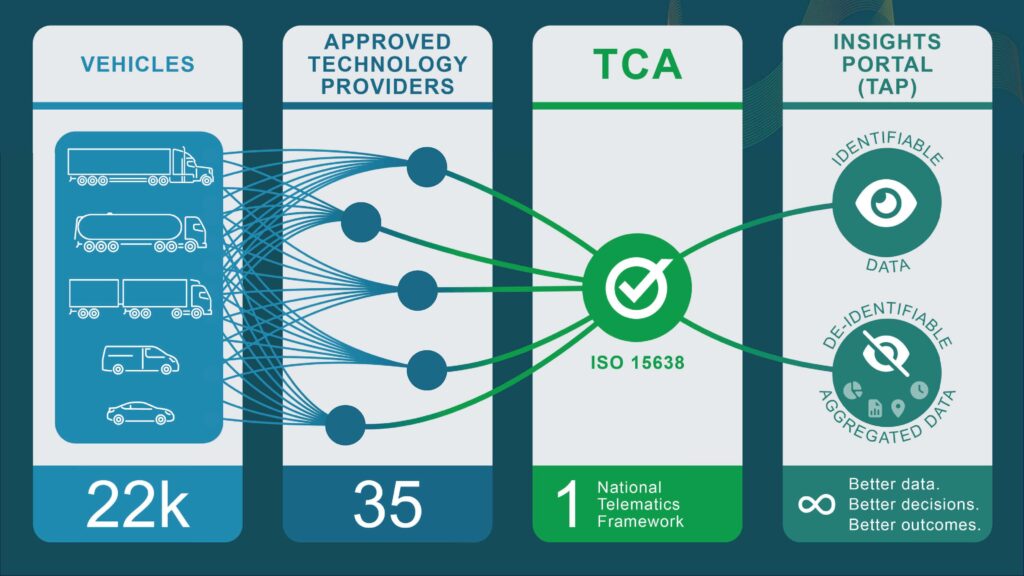
National Telematics Framework graphic: Austroads. Used with permission. Figures shown are those in the supplied graphic, not a current fleet count.
The difficulty in fitting telematics may be finding time to stop the truck as much as finding the equipment. Before booking fitment, an operator can put six practical questions to the proposed provider.
1. What result are you supplying?
Ask the provider to identify the vehicle, access scheme and monitoring service covered by the offer. The Telematics Monitoring Application (TMA) is the vehicle-monitoring application discussed here. Where Smart On-Board Mass is required, TCA says the type-approved Smart OBM system also needs a certified application service provider that supports the pairing.
2. What happens to the existing equipment?
An existing tracking device or onboard mass system should be assessed rather than assumed to meet the requirement. Ask what can remain, what must change and why.
3. When will the vehicle be ready?
Separate the installation appointment from readiness for the intended operation. Ask how long fitment takes, what enrolment follows and how completion is confirmed. Austroads general manager of strategic engagement and performance Gavin Hill told Which Way To Go that TMA turnaround was generally measured in days to a couple of weeks at the time of interview, but that was not a guaranteed appointment or delivery promise.
4. Who handles a fault?
TCA’s TMA Functional and Technical Specification version 1.6 gives certified providers explicit malfunction responsibilities. Providers must monitor system health and report malfunctions to TCA. For device malfunctions they must liaise with the operator and/or device supplier and complete the resolution process within 15 working days of becoming aware of the malfunction, subject to reasonable operator cooperation. A separate requirement covers the provider’s own system — the hardware and software used to collect, process, store and report TMA data. The provider must have enough equipment and resources to return that system to operation within three working days if a component becomes inoperable. This is not a three-day repair promise for every device fitted to a truck.
Those are certification requirements, not a promise of compensation or a supplier-specific commercial warranty. Ask who your first contact is and what the contract provides beyond the certification minimums.
5. What is included in the price?
Have the supplier distinguish monitoring, hardware, installation, optional tools and support. Record minimum terms and additional charges so competing offers can be compared on the same basis.
6. What is approved now?
Ask for the exact approved system and pairing relevant to the proposed operation. TCA’s Smart OBM pairing list shows approved systems and their supported application service providers. A technically functioning product should not be described as an approved regulatory solution unless the applicable approval supports that use.
For Queensland hydraulic-suspension low loaders, Queensland’s Department of Transport and Main Roads says its current focus is TMA for eligible vehicles. Certified Smart OBM is not currently available for that application and is not part of the current implementation arrangements. Check the vehicle’s actual access conditions before ordering equipment.
These questions are a framework for obtaining an offer specific to the business, not a substitute for checking the access conditions applying to the vehicle and task.